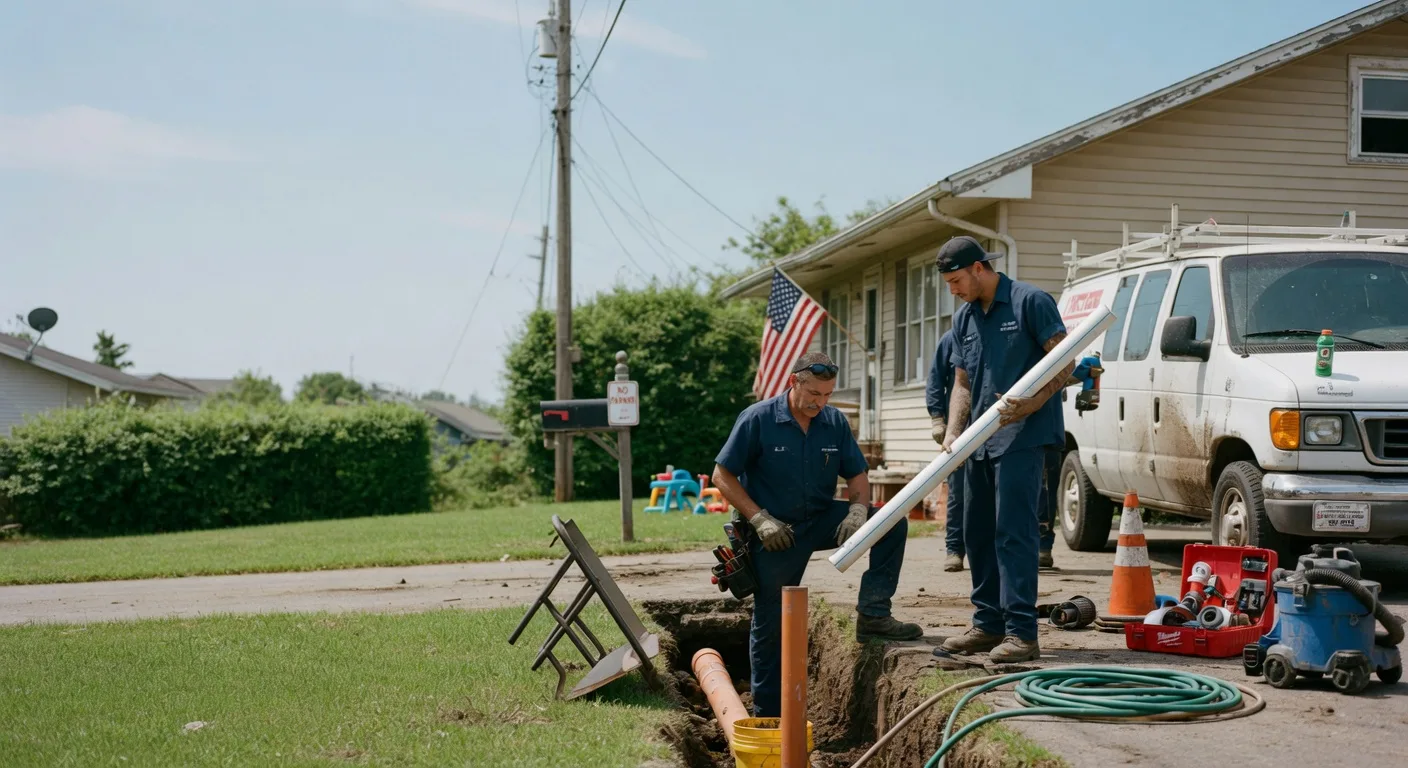
What is the difference between a septic system and a city sewer line for drain problems?
The two systems fail in different places, so the first job is knowing which one your home has. A city sewer line carries wastewater from your house to a municipal main, so trouble is usually confined to the pipe: roots at a clay joint, a bellied section, scale in old cast iron, or a blockage in the lateral. Every drain in the house backing up at once typically means the private line or the connection at the street. A septic system adds a buried tank and a drain field. Solids settle in the tank, and liquid flows out through perforated pipe into the soil. Slow drains or backups can mean a tank that is full and overdue for pumping, a clogged outlet filter or baffle, a failing drain field that can no longer absorb water, or a blockage in the short line between the house and the tank. Soggy ground or a strong odor over the tank area points away from the house plumbing. A cable machine or hydro jetting can clear the house line on either system, but jetting into a septic line needs care about where the water and debris end up. Property paperwork, a cleanout location, or the water utility can tell you which system you have. Expert Plumbers Co connects homeowners with an independent local plumber who works on that type of system.
Homeowners often assume a septic problem and a city sewer problem look the same from the bathroom, but there are a few quick clues. On city sewer, a backup after heavy use is usually the private line or the lateral at the street, and neighbors on the same main may have had the same trouble. On septic, the problem tends to build slowly: drains slow down across the house, the toilet flushes weakly, and a patch of lawn stays wet or unusually green. A common mistake is pouring additives into a septic tank hoping to fix a failing drain field. They do not repair soil that has stopped absorbing water. When you call, tell the plumber how old the system is, when the tank was last opened, and where the cleanout or lid sits. In older homes the tank may be buried deeper than expected and need to be located first, which adds time before any repair starts.
Can my downspouts or sump pump cause a sewage backup?
Every drain is gurgling and dirty water comes up the basement floor drain, but only when it rains. That is not one slow sink. Storm water is a prime suspect.
In older housing stock, gutters, a yard drain or a sump pump discharge were sometimes plumbed straight into the sanitary sewer. In a storm, all that extra water floods the house lateral and the municipal main. The pipe runs full, so sewage is pushed back up the lowest opening: a floor drain, a basement shower, a laundry standpipe.
Many jurisdictions now prohibit this. Disconnecting it is often a permit or code matter.
Safe homeowner check: walk the outside of the house. See where each downspout ends. Does it spill onto the ground, or vanish into a pipe in the soil? Does the sump pump discharge run out to daylight, away from the foundation, or into a pipe tied to the house drain? Look only. Do not dig.
Stop running water and call now if more than one fixture is backing up, if sewage is rising, or if it is reaching the floor. A single slow sink is a different job, and a cable machine usually handles it. A storm-driven backup is not a clog, so cabling will not cure it.
A plumber finds the connection with a camera inspection, which shows a tie-in on the pipe, or a dye test, where colored water poured into a downspout or sump shows up in the sewer. What the work involves depends on access, the materials, how much has to be opened up, and any permit requirement.
Expert Plumbers Co is a referral service. We refer homeowners in Kenosha, WI to an independent local plumber for Drain Cleaning and Emergency Drain Cleaning. Call (380) 262-9173.
Once the connection is found, the usual fix redirects the storm water instead of changing the sewer. Downspouts can be extended to discharge onto the ground well away from the foundation, with the soil graded to carry water off. A sump discharge should run outdoors to daylight or to a drainage point that local code accepts.
A common mistake is capping the old pipe at the wall and leaving the buried tie-in open to the sewer. An open stub can still admit soil, roots and water. Ask the plumber to confirm the old connection is sealed at the sewer end, not just hidden from view.
Sump pumps run hardest during the very storms that load the sewer, so a pump that cycles constantly is worth mentioning on the call. After the change, watch the next heavy rain. The floor drain should stay quiet. If it still gurgles, the cause may be the street main or a damaged lateral, not the tie-in.
Can a drain under a concrete slab be cleared without breaking the floor?
Usually, yes. Clearing a blockage and repairing a broken pipe are two different jobs, and only the second one needs the floor opened.
In a slab-on-grade house the drain lines run inside or beneath the concrete. There is no crawlspace to inspect, so symptoms are the only evidence you have. A cable or a hydro jetter still reaches the line through a cleanout or through a pulled toilet. Grease build-up on the pipe wall, roots in a joint and scale in cast iron can all be cleared that way.
What does need the floor opened is a cracked, collapsed or bellied section under the slab. A bellied line holds water and collects waste however often it is cleared. In older housing stock where clay or cast iron was the standard, failed sections are more likely.
A camera inspection with a locator pinpoints the fault. The plumber finds the exact spot and marks it on the floor before anything is cut, which keeps the opening small. What the job involves is driven by access, the materials, how much concrete must be opened and removed, and any permit or code requirement. Opening a slab often brings one in.
Safe homeowner check: note whether one fixture is slow or every drain is affected. A single slow fixture is usually a cable job on a branch line. Every drain backing up points to the main line or the sewer lateral.
Stop running water and call now if the whole house is backing up. Report water staining or a warm, damp patch on the floor, because it can mean a leak under the slab.
Expert Plumbers Co is a referral service. We refer homeowners in Kenosha, WI to an independent local plumber. Call (380) 262-9173.
A spot repair under a slab is more disruption than most people picture. The plumber breaks out a section of concrete, digs down to the pipe, replaces the damaged length, and the floor is patched. Dust, noise and a few days without some fixtures are normal. Furniture and flooring over the area must be moved first, and tile or a finished floor may not match after patching.
For longer runs of damage, some plumbers can line the pipe from inside, or route a new line overhead or outside the house, which avoids cutting the slab. Whether either suits your pipe depends on its condition and on local code.
Ask to see the camera footage and the locator mark on the floor before any cutting begins. Mention in-floor heating, radiant tubing or a post-tension slab if you have one. Cutting into those without knowing is dangerous, so the plumber needs to hear about them before a saw comes out.
Our main line backed up the day after a big family gathering. Did all those guests cause it?
Probably in part, but usually not on their own. A house full of guests puts far more water and waste through the drains in a day than the plumbing sees in a normal week: extra toilet flushes, showers, dishes, laundry, and a lot of toilet paper and food scraps. A healthy sewer line takes that in stride. A line that was already narrowed will not.
That is the common story. Roots at a clay joint, grease coating the pipe wall, a low spot that holds water, or scale in old cast iron can leave the line working at half capacity. Daily use hides it. Then a crowd of people finishes the job and the water has nowhere to go.
Some party habits do add to the problem. Grease and fat from cooking poured into the sink, food pushed into the disposal, paper towels and napkins in the toilet, wet wipes and feminine products all build up quickly. Guests do not know what the house can take.
Look at how the backup shows. If one toilet or sink is blocked, the trouble may be local to that fixture. If several drains are slow, a toilet gurgles when something else runs, or a basement drain or tub fills, the main line is the likely cause.
Safe checks you can do:
Stop using water, including the washer and dishwasher. Do not keep flushing to see if it clears. Keep people off wet floors.
Stop running water and call now if sewage is coming up inside, especially in the basement or a tub.
A cable machine often clears a mass of paper and grease. If the line backed up under a normal load before, or comes back after clearing, a camera inspection shows whether roots, a belly or a damaged section are the real reason. Cost depends on where the blockage sits, access to the cleanout, the tools needed and whether any repair follows, including permits under local code. To be connected with an independent local plumber in Kenosha, WI, call Expert Plumbers Co on (380) 262-9173.
We wash the dog or muddy gear in the tub or laundry sink. Can sand and mud clog the line?
Washing the dog in the tub feels harmless. The water runs away, the bathroom smells of wet fur, and an hour later the tub drains slowly. Muddy boots, gardening gear and sports kit in the laundry sink do the same thing over time. Yes, sand and mud can clog a line.
The problem is how they travel. Water carries sand and grit along, but only while it is moving fast. In a trap, a flat run or a low spot in the pipe, the flow slows and the grit drops out. It settles, packs down and mixes with pet hair, soap and grease to form a dense sludge. Each wash adds a little more. Eventually the pipe is narrow enough that normal use overflows it at peak load.
Hair and grit also catch on any rough spot, such as scale in cast iron or a root mat at a clay joint, and a bellied line holds the settled material in place. It does not flush away on its own.
The key question is where it is happening. If only the tub or laundry sink drains slowly, the clog is likely in that fixture's trap or branch line. If the toilets gurgle and other drains back up as well, the sludge has moved into the main.
Safe homeowner check: stop washing pets or gear in the tub and laundry sink for now. Fit a fine hair catcher over the drain. Use a bucket and the yard hose for muddy boots and dog baths outside when weather allows. Do not pour chemical drain cleaners into a line with packed sand, since they do not dissolve it.
Stop running water and call now if sewage or gray water is coming up in a tub or floor drain, if the drain is overflowing, or if you smell sewage. Do not keep running the washer while the line is backed up.
A cable machine can open a path through packed sludge, but it often leaves settled sand behind, so the drain slows again. Hydro jetting flushes the sand and mud out of the line. If the trouble keeps returning, a camera inspection shows whether a belly, root intrusion or damaged joint is trapping it.
Expert Plumbers Co is a referral service. We connect you with an independent local plumber in Kenosha, WI. Call (380) 262-9173.
Tell the plumber exactly what goes down the drain, including pet washing. Ask whether the trap was cleaned and whether the main was jetted or only cabled. Scope depends on access, how far the buildup extends, whether a section has to be opened up, and any permit or code requirement for repairs. A cleanout near the fixtures makes future service simpler.